Post
Understanding numbers and Risk when making informed decisions about any aspect of your…
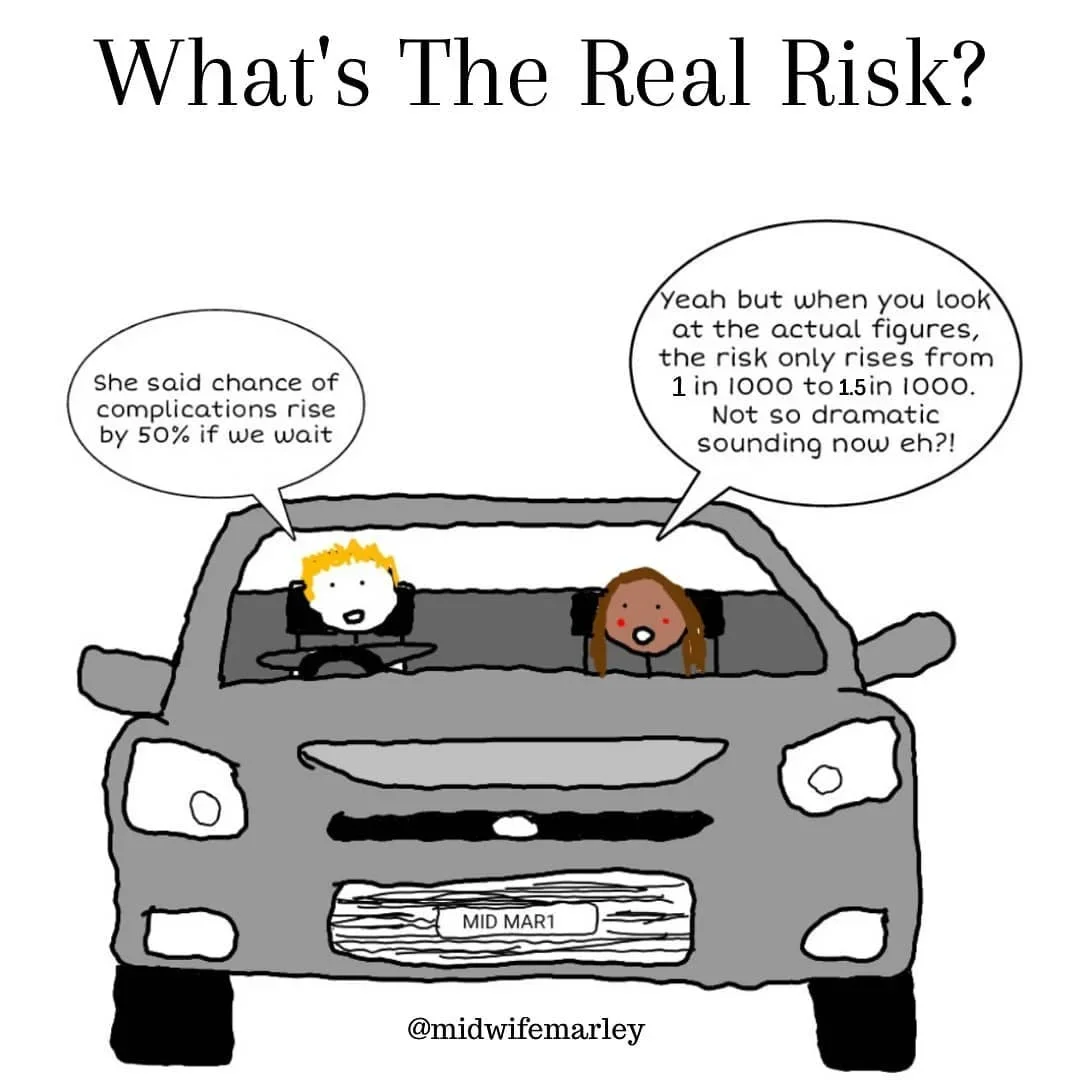
Understanding numbers and Risk when making informed decisions about any aspect of your health/maternity care.
Have you ever heard words to the effect of "50% increased risk of..." or "number of people with x condition soar by 60%"
Sounds scary doesn't it?
It doesn't mean much without baselines figures however. Let me show you what I mean.
If the chance of you turning into a banana is 1 in 1000 but this risk is increased by 50% if you are over 40 years old, the chance is then 1.5 in 1000. This is called the relative risk - relative to the number of people out of every 1000 that actually turn into bananas.
The absolute risk of you turning into a banana however is 0.01% and creeps up to just 0.015% at 40 years old. Barely anything, certainly not as frightening as hearing "50% increased risk"
If the odds given are based on smaller groups ie 1 in 4 people etc, absolute risk will always be much higher.
Although relative risk does provide some information about risk, it doesn’t say anything about the actual odds of something happening; on the other hand, absolute risk does.
If you are ever faced with making a decision about your health or care based on being given relative risk figures Ie 30% more likely or 5 times higher chance, always ask what the baseline figure is so you know whether the absolute risk will be significant or not.
It might take you a few times of reading this post before it clicks but when it does, it might be a real eye opener! Save it to read later for future reference 😊